

Kwanzaa Through a Black Jewish Lens
November 12, 2025 | Jewish Traditions and Values
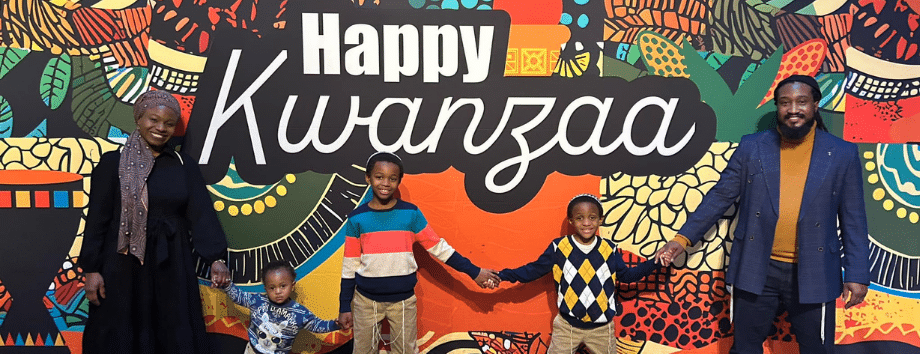
Written by Rabbi Tzadik Womack, an active participant in Jewish Connection Network events, PJ Library subscriber and prominent advocate for inclusion within Jewish spaces. Rabbi Womack lives in Baltimore, Maryland, where he attends Ner Tamid Greenspring Valley Synagogue. He received rabbinic ordination and is also a practicing attorney.
What is Kwanzaa? Why is it meaningful? Is it a religious holiday? These questions have been asked repeatedly since the holiday’s creation in the 1960s. For members of the Black Jewish community, an even more personal question may arise: How can I observe Kwanzaa—or should I? This essay is my attempt to address these questions in accordance with halacha (Jewish law).
What is Kwanzaa:
Kwanzaa is an African American and Pan-African holiday created by Maulana Karenga. In his book Kwanzaa: A Celebration of Family, Community, and Culture, he explains that the holiday draws on African culture to “build community, enrich Black consciousness and reaffirm the value of cultural grounding.” Rooted in a synthesis of first-fruit celebrations across Africa, Kwanzaa employs values and symbols to strengthen communal identity.
This background naturally raises another question: What is Pan-Africanism? Pan-Africanism affirms the unity of African peoples worldwide. Some points emphasized in Pan-Africanist thought are solidarity in economic markets, a return to Africa and the principle that Africa belongs to Africans.
Much like the Jewish maxim Kol Yisrael arevim zeh bazeh (all Jews are responsible for one another), Pan-Africanism views African peoples, both on the continent and in the diaspora, as sharing a common history and responsibility. It is important to note, however, that Pan-Africanism is largely a diasporic creation. Although Pan‑Africanist thinkers are present in Africa, Africa’s ethnic groups maintain distinct traditions and efforts to unify them often demonstrate the diaspora’s loss of direct connection to specific traditions.
How is Kwanzaa Celebrated
Kwanzaa is observed through values and symbols that highlight community and heritage. Each night, a candle is lit in the Kinara to represent one of the seven principles, the Nguzo Saba.
The Nguzo Saba (Seven Principles)
- Umoja (Unity): “To strive for and maintain unity in family, community, nation, and race.”
- Kujichagulia (Self-Determination): “To define ourselves, name ourselves, create for ourselves, and speak for ourselves.”
- Ujima (Collective Work and Responsibility): “To build and maintain our community together and make our brother’s and sister’s problems our problems and to solve them together.”
- Ujamaa (Cooperative Economics): “To build and maintain our own stores, shops, and other businesses and to profit from them together.”
- Nia (Purpose): “To make our collective vocation the building and developing of our community in order to restore our people to their traditional greatness.”
- Kuumba (Creativity): “To do always as much as we can, in the way we can, in order to leave our community more beautiful and beneficial than we inherited.”
- Imani (Faith): “To believe with all our heart in our people, our parents, our teachers, our leaders and the righteousness and victory of our struggle.”
The Symbols of Kwanzaa
- Mazao (Crops) — reward for productive labor
- Kinara (Candle Holder) — roots on the African continent.
- Muhindi (Corn) — children and the future.
- Mishumaa Saba (Seven Candles) — the seven principles.
- Kikombe Cha Umoja (Unity Cup) — unity.
- Zawadi (Gifts) — labor and love of parents that are presented to children.
- Mkeka (Mat) — represents the foundation of our history/traditions.
During our family’s celebration, we light the evening’s candle and discuss the principle it represents, reflecting on how to apply it in our lives. We also honor our ancestors—parents, grandparents, and close friends—whose stories embody these values. These include Black ancestors, both Jewish and non-Jewish, whose legacies are integral to our family.
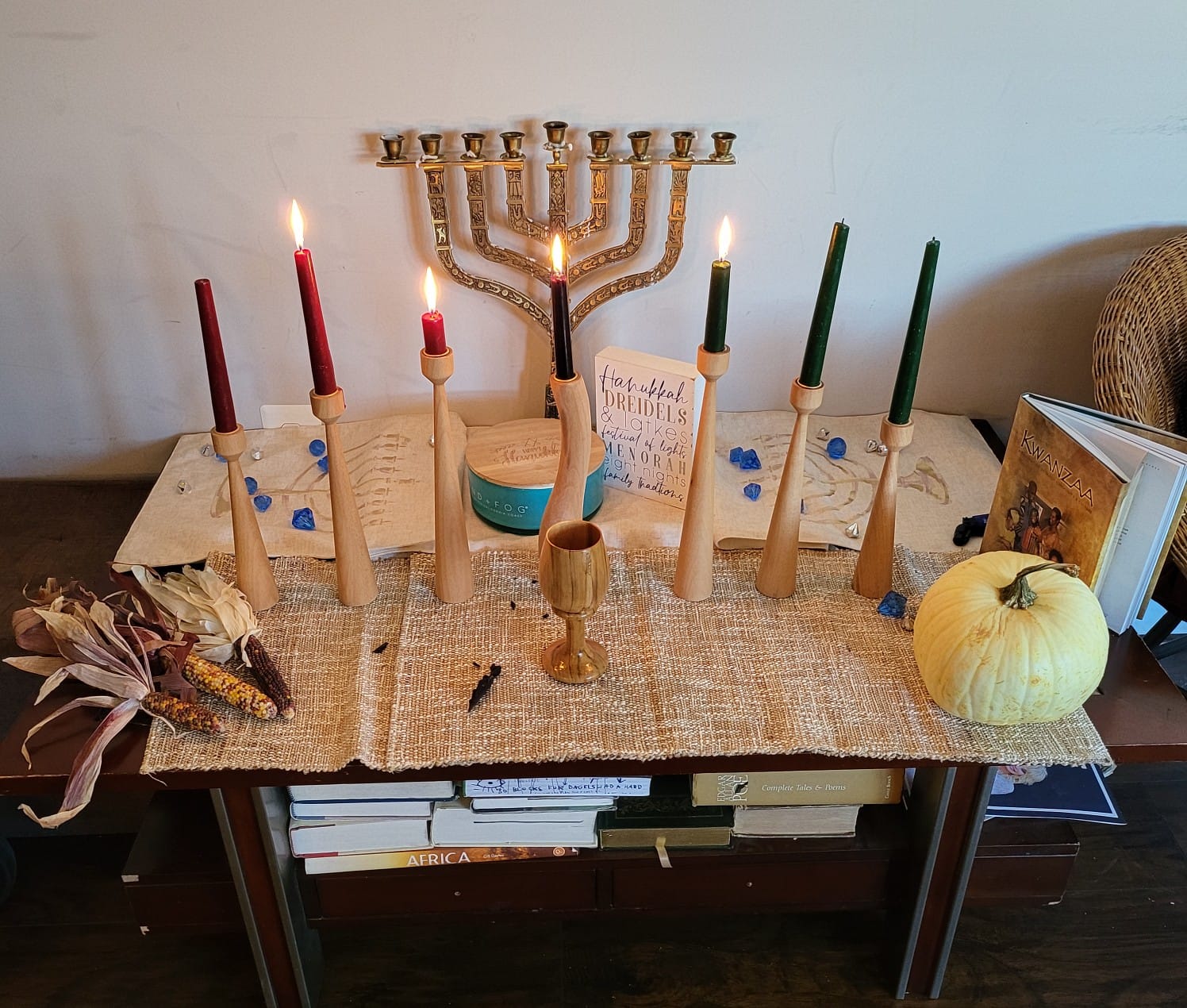
Halachic (Jewish legal) considerations arise as well. A person is forbidden to replicate the items that were used in the Temple. Additionally, there are discussions on whether one is allowed to retain an item that is a replica of what was used in the temple. when I began observing Kwanzaa, I consulted my Rav (rabbi), who instructed me to be stringent in this matter. Therefore, my family uses individual wooden candle holders instead of a formal Kinara (see photo above). Similarly, while the Kikombe Cha Umoja (unity cup) is traditionally used for libations, concerns about avodah zarah (idolatry) led my family to adapt the practice: instead of pouring libations, we sip rooibos tea from the unity cup—a nod to Africa —and conclude with the harambee chant, meaning “let’s all pull together.”
Why Kwanzaa Matters
The purpose of Kwanzaa is to cultivate pride and identity. Jewish survival in galus (outside of Israel) has depended on preserving our language, religion, traditions and cultural practices. By contrast, white supremacy’s enduring impact has been the disconnection of Black/Diasporic Africans from language, religion, traditions and culture. Too often, history is still taught through the lens of those who severed that connection.
Kwanzaa offers a way to reclaim cultural experience and shape pride from within, rather than through oppressive narratives. For Black/Diasporic African Jews in the United States, it can serve as a meaningful cultural institution.
This is not a call for non-Black Jews to appropriate the tradition. Support your friends and participate if invited but avoid co-opting another community’s catharsis.
Closing Thoughts
Kwanzaa is not a religious holiday but a cultural one. For Black Jews, it can be a powerful means of reconnecting with heritage, affirming identity, and strengthening community. Observed thoughtfully, it can be a profoundly meaningful experience.