

A Journey of Belonging
November 12, 2025 | Jewish Traditions and Values
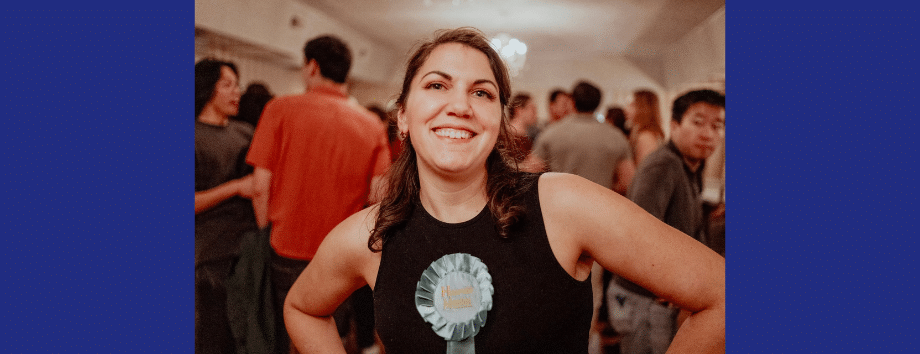
By Lindsay Feldman, Shalom Social Club Connector (for 20s-40s in Baltimore City).
“Tell me about your Jewish journey,” was how the conversation auspiciously began.
I was sitting on the floor at Baltimore Polytechnic Academy in the middle of a teacher training day as I spoke with Erica Bloom, Senior Director of the Jewish Connection Network, all about my project, Shalom Social Club. “I saw a gap in programming for Jewish adults past their twenties in Baltimore, so I’ve been doing this thing,” I explained.
While I teach public school full-time, long have I moonlighted in Jewish collective service, but people who learn more about my childhood are surprised about where I’ve ended up. You see, of the fifteen cousins in my family, I’m the only Jewish one.
Growing up my parents were veterinarians and small business owners. They were busy juggling clients, a menagerie of animals at home, and the chaos of three kids (me, my twin sister and an older brother). My mom was raised Catholic as one of eight siblings, and my dad only remembers his parents in synagogue once with him—at his bar mitzvah. Betty and Steven were married at a Bahai temple in Illinois right after veterinary school before moving to Maryland.
From talking with other kids of intermarriage our holidays were pretty normal; Christmas tree in the living room, menorah in the window, nine days of presents, colorful easter eggs peeled for the Passover table. Mom got enough church growing up in her family, but she wisely explained, “everyone has a holiday to bring in life and light in the longest, darkest time of the year.”
When the high holidays came around or a minyan was needed, I jumped at the chance to go to synagogue with my father. I remember seizing any opportunity for my dad’s complete attention. I’d put on a long skirt before hopping into the backseat of our Chevy Suburban, and remember often dozing in the golden hour light.
The southern Maryland synagogue I attended growing up wasn’t a grand, century-old structure like where I’m a member now. It was a modest, mid-century building that now houses a church. I remember wrapping myself in my dad’s tallit, braiding and twisting the fringe as the melody of Hebrew I couldn’t read reverberated off the sanctuary walls. Since two of their three kids only attended synagogue with much resistance and attitude, my parents elected to not battle small humans on a weekly basis to take us to Sunday school. My dad’s Jewish education trickled down to me and I remember him showing me what adonai looked like (יְיָ). Reading the letters and matching them to the prayers helped me find my place, like they did for him.
When I went off to college at the Maryland Institute College of Art, I faced the same question that many young adults do: What do I choose to carry with me? I dyed and wove my own tallit and did Judaism where I could—sometimes at MICA, sometimes at Towson or Johns Hopkins Hillel—wherever I could find a familiar melody or a free kosher meal.
Just before graduating I landed a job interview in Allentown, Pennsylvania, rented a car, printed out directions from Mapquest, and crashed the night before with a friend’s family. They assumed I was dating their son (I wasn’t), but by the end of the visit, I’d been unofficially adopted. The Miners were a warm Chabad family who welcomed me with open arms and infinite food. That year became the first time in my life I’d ever really experience Judaism in the home. I drank coffee on Shabbat mornings with Joe’s mom, Sue, before we walked to shul. I wasn’t about the mechitzah (a physical divide between the women’s and men’s section at some traditional synagogues) but I loved that dishes and crumbs languished in candlelight on Friday nights, and Saturday afternoon held the frequent promise of napping with dogs. I was learning that being Jewish didn’t have to mean synagogue or rules—it was about living life with a Jewish rhythm. Dave and Sue Miner taught me that the meal doesn’t matter as much as the company, though in their home, both were always abundant.
Those lessons in Judaism, learned at countless dinner tables and holiday gatherings, eventually led me to create my own Jewish home for others: Shalom Social Club. I am grateful, too, for the numerous traditions my mom shared–making Christmas cookies, quiet toys in stockings, and her ability to see similarities where others noticed differences.
All of my aunts and uncles respected my religion and often remarked that it was odd that between my brother, my twin and I, I was the only one. My mother also has shared moments where Sisterhood members admonishments caused her to feel shame. Their unwelcome attitudes distanced her from my fathers’ religion, and for many years kept her from enjoying the rich melodic voices of our family friend, a cantor. Despite a conservative conversion, I, too, have experienced moments of questioning–”am I Jewish enough? Why don’t I feel like I belong?” Judaism isn’t something I inherited, and I feel like I appreciate it all the more for that. Being Jewish is something I have chosen, over and over again—through every song and melody I learned by ear, every meal I shared, every community I’ve been a part of and every newcomer I’ve embraced.
My parents didn’t plan to raise a Jewish daughter. And yet, here I am: a proud Jew-by-choice, an unlikely founder of a Jewish social club and part of the growing group of Connectors serving Baltimore’s Jewish adults. What started as a handful of casual get-togethers has grown into a vibrant community with monthly happy hours (“Kibbitzes”), volunteer projects, and plenty of opportunities to learn, laugh, and be Jewish together. I started Shalom Social Club in Baltimore to serve people like me—Jews-by-choice, patrilineal Jews, Jews with minimal Jewish education, and anyone who ever felt “on the edge” of belonging.