
The Trip of a Lifetime: Jewish DeafBlind Adults Explore Israel for the First Time
January 26, 2026 | Israel & Global
By Yael Zelinger, Jewish DeafBlind Experience, Coordinator
For many members of the Jewish DeafBlind community, traveling to Israel as a fully accessible Jewish group has been a long-held dream. For years, participants in Jewish DeafBlind Shabbatons talked about what it might mean to experience Israel in a way designed specifically for their needs.
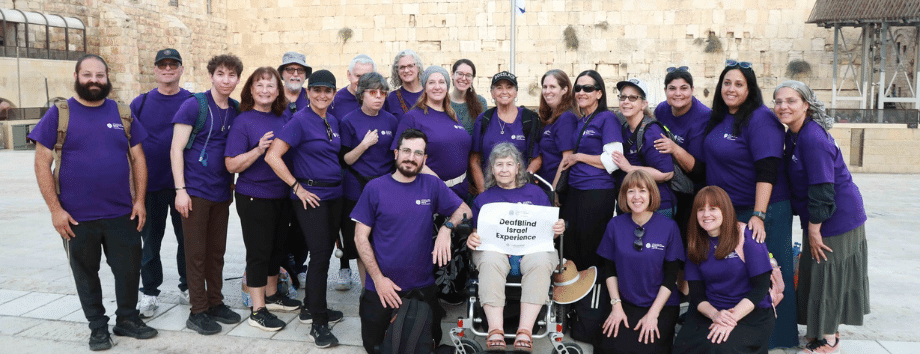
In November 2025, that vision became reality. Six DeafBlind participants, 12 Support Service Providers (SSPs) and I traveled to Israel for a carefully planned, accessible Jewish experience. Every detail was considered so that communication access and meaningful engagement were possible at every step. We experienced Israel through touch, taste and smell—and came away breathless, amazed, laughing and exhausted in the best way.
I’m excited to share one day from the trip, offered as a window into how the experience unfolded.
Experiencing Masada
The day began with camel rides. Each DeafBlind participant rode with a sighted partner, holding on tightly as the camels rose until we felt improbably high above the ground. The movement was slow and swaying as our Bedouin guide led us in circles. Getting down was its own adventure: the camels folded themselves forward at a steep angle before settling into a crouch, and we used stools to dismount safely.
From there, we traveled to Masada and took the cable car to the top. The site was crowded, but staff allowed our group to ride together, which helped enormously. The view was stunning. Several participants with residual vision were able to see parts of the landscape depending on the lighting. One woman cleverly took photos and enlarged them on her phone so she could better take in the view.
At the summit, Rabbi Yehoshua Soudakoff shared the history of Masada in ASL. SSPs interpreted one-on-one for each participant—sometimes visually, sometimes through tactile signing directly into their hands. When he taught, the space became quiet and focused. Hands moved, bodies leaned in and attention settled fully on the story being shared.
A tactile model of Masada helped bring the site to life. Rabbi Soudakoff guided each participant through it individually, allowing them to explore the layout with their hands and better understand we were standing together.
Floating at the Dead Sea
Next, we drove to the Dead Sea. Wading the water together was such a bonding moment. For two women with balance challenges, we placed plastic chairs in the shallow water so they could sit comfortably and take part. The salt, sand and water made the experience sensory and fun. We floated, laughed and talked.
When I eventually leaned back and floated myself, I felt an unexpected sense of peace. I kept thinking about how, for someone who is DeafBlind—someone often guided, touched and physically assisted—floating might feel incredibly freeing. Just water, sky and stillness.
The Role of the SSPs
While the trip centered on the DeafBlind participants, the SSPs were deeply impacted as well. One reflected:
“…we became this living organism—ecosystem kind of thing that even now, more than a month later, feels hard to dismantle or unravel (and I hope it doesn’t!). On most interpreting jobs, there’s understandably concern over workload balance. Here, however, volunteers moved seamlessly between tasks, organically filling in whenever they noticed a need—even when it wasn’t ‘their’ DeafBlind person.”
The group met regularly before and during the trip to talk through challenges, share observations and adjust plans as needed. That ongoing collaboration helped create an environment where everyone felt safe and comfortable.
Several participants and SSPs who had been to Israel before commented that this trip felt different—slower, more intentional and clearly shaped around access. Each day required flexibility, patience and teamwork. Rabbi Soudakoff remained warm and upbeat throughout long days, adapting plans as needed while keeping the group engaged.
Carrying the Experience Forward
This journey became more than a visit to Israel. It fostered a strong sense of belonging—within the group, within the Jewish community and within the land itself. Trust and connection were built through shared experiences, communication and time spent together.
The trip ended, but its impact did not. The relationships formed during those nine days remain active through shared messages, photos and ongoing conversation. What began as a carefully planned travel experience became something lasting: a community built through intention, access and shared experience.