

Being a GRANDparent… is GRAND!
January 26, 2026 | Tips and Resources
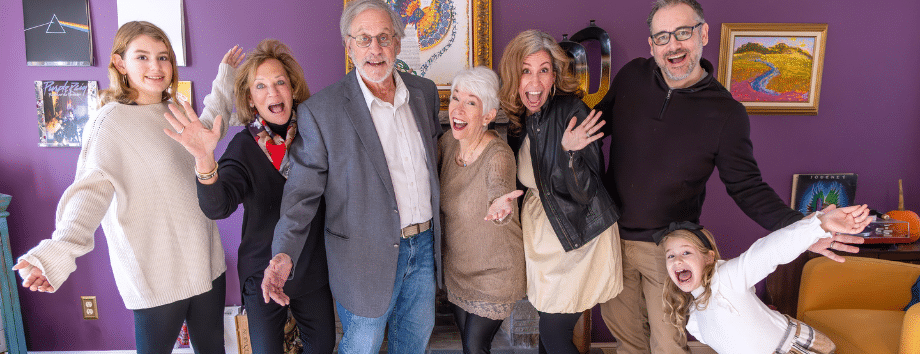
By Sheri Stern (center in photo), Special Needs Grandparent Support Group Participant
On the day before our first Seder in 2014, my daughter, Michelle, and son-in-law, John, told my husband, Jeffrey, and I that we would become grandparents that November. In that moment, we became Pop-Pop and Bubbe, our self-selected names, and we have been “becoming” grandparents ever since, alongside our two granddaughters, Rowan (11) and Sydney (6).
As much as we love our two biological adult children & our “son-from-another-mother” John, we had no idea just how completely, wildly in love we could be until our Grands entered our lives.
Anyone who is a grandparent knows it is truly GRAND. It’s the best unpaid job with the best benefits ever – deep down in our hearts and neshamas (Yiddish: souls). We have dreams for our grandkids, just as we did and do for our children. Every time our Grands call me Bubbe, I melt a little… okay, a lot! Every time they spontaneously hug me, I get fahrklempt (Yiddish: teary-eyed)!
Rowan was almost five when Sydney was born; she demonstrated all the usual developmental milestones that pediatricians, parents and grandparents watch for and document in clinical notes and baby books. Not so for Sydney. Before age two, she experienced excessive crying and screaming, limited social interaction, parallel play instead of engagement with peers, difficulty responding to her name, severe sensory sensitivities with food that led to weight loss, delayed speech and intense separation anxiety from her mom.
The years when Sydney was between two and five were incredibly painful for all of us. Watching Sydney’s behaviors, sad and anxious emotions, stimming, her inability to control her emotions and behaviors by self-calming and her parents’/sister’s and our responses, was like being in a nightmare that we couldn’t wake up from. Despite our best attempts at empathy, patience and seeking help, there were moments filled with guilt whenever anyone, including myself, yelled at her for her behaviors, knowing she was not doing it on purpose but because she had some kind of yet-known illness, tore me apart. Jeffrey and I felt helpless and a sense of loss for all three generations: for ourselves as Grandparents, for both of our granddaughters, and for our own children, Sydney’s parents, who were also grieving and at their wits’ ends.
While our kids took Sydney for different therapies as young as two years old, despite not having a diagnosis yet—occupational therapy, speech therapy, social skills group—and transferred her from her private pre-K to their public school’s inclusion program with teachers and aides certified in Special Needs (one of the best decisions!). At three and a half, Sydney was evaluated by a neuropsychologist and diagnosed with mild Autism Spectrum Disorder. She received an IEP at school and some reimbursements for clinically indicated therapies. When she got kicked out of a special needs camp on the first day due to her behaviors, that was another major life-changing point. Our children took her for an evaluation with a child psychiatrist and medication was initiated for her symptoms. WHAT A POSITIVE DIFFERENCE!
Within weeks, we began to notice some small positive behavioral differences. Within months, there were more. Sydney began asking for playdates with other kids from school and actually playing with them. She stopped crying whenever her mom left the house and whenever she was dropped off at school! She began taking the school van ride to and from school, instead of her parents needing to drive her there. She began to experience fewer and shorter emotional meltdowns, and sometimes none at all for incidents that had previously triggered them. She began coming home from school excited to show her mom and dad what she did that day. And she became interested in learning to write her letters and frequently asks Bubbe to give her math problems to work out in her head. She’s now able to comfortably stay in a classroom of 22 children with one teacher and one aide for the full school day. Once in a while, she tells us calmly that we’re speaking too loudly, and sometimes she just puts her earphones on to reduce the noise. She’s all about gymnastics, frequently cartwheeling anywhere she can and asking, “Bubbe, what number would you give me for that? A 10?!” Not only does she take her medications twice daily, but she also reminds her parents if they haven’t yet given her the afternoon dose! What a blessing to see her growing confident, competent, and happy!
It was during those painful years that I began searching for a grandparents’ support group for those who had grandchildren on the spectrum, because I recognized that I personally needed support and resources on how to cope with this new ongoing experience. Once Sydney did receive a diagnosis, I’ll never forget what our daughter said to us: “I just don’t want you to look at her and treat her differently now.” I believe our daughter and son-in-law would say that Pop-Pop and I have passed that test.
After finding mostly virtual groups meeting monthly or several times a year, I decided to create my own monthly grandparents support group by partnering with a local family mental health organization. At around the same time we began our group, I received an email about another grandparent’s support group forming locally in person for those with grandchildren with any special needs, and eventually, the groups merged and found a home with The Jewish Connection Network.
The group has helped me feel like I belong to a special group of loving grandparents facing similar challenges and joys, who both receive and give support to each other along with skilled, compassionate professionals, rather than feeling isolated in our own circumstances. Together, we share great resources, realities, heartbreaks, coping strategies, and moments of hope.
While Sydney has made tremendous strides over the past year and a half and our own needs have shifted, Jeffrey and I plan to stay involved for a while longer, to pay it forward. We may not always be able to fix the challenges our families face, but isolation is a choice. Connection is also a choice, one that allows us to both receive and give support.
In the words of Hillel in Pirkei Avot:
If I am not for myself, who will be for me?
If I am only for myself, what am I?
And if not NOW, WHEN?
In hope,
Sheri Stern
aka Bubbe